In recent memory, there has been much interest on nasi ambeng and in response to requests for me to talk about it, I presented my thoughts with “From Ritual to Table – Nasi Ambeng as Culinary Heritage” on 29 May at the Malay Heritage Centre.
Coincidentally, it was also the 5th Anniversary of the opening of the exhibition on the Javanese community in Singapore.
Gathering much of the things I know, the ritual communal meal that is affectionately known as nasi ambeng tend to be a cursory reference in much of the literature about Javanese culture.
In reading the compendium on Javanese culture by Prof Koentjaraningrat, the first reference was as “lauk-pauk slametan” or the side dishes for slametan.
Slametan is the thanksgiving ritual that has been quite synonymous to Javanese culture but known here in Singapore as ‘kenduri’ or ‘majlis doa selamat’.
In the past few years and for this Singapore Heritage Festival, there is much written about nasi ambeng.
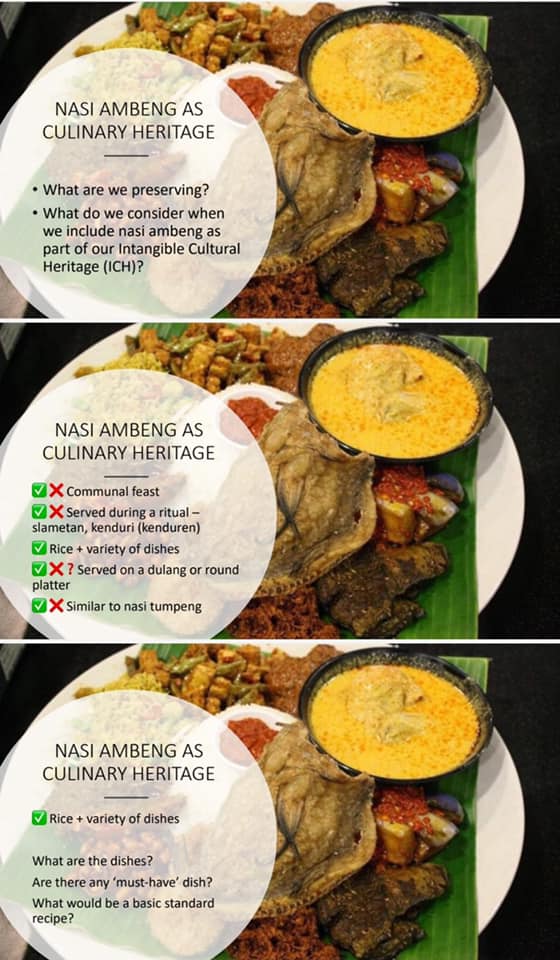
In reading most of them, and adding my own understanding, the memories and imagination of nasi ambeng seems to be:
(1) communal feast and also, communal cooking
(2) part of a ritual – slametan/kenduri
(3) rice with a number of side dishes
(4) served on a dulang or round platter/tray
(5) similar to nasi tumpeng
In addition to the above, I shared that the reference to “nasi ambeng” could be peculiar to Singapore, Malaysia, and to some extent, in Suriname.
In most other places, including Indonesia, it is referred to as nasi tumpeng or nasi berkat. Of course, when it is a nasi tumpeng, there are features that would be more distinctive.
Hence, the reference to “nasi ambeng” could be a peculiar cultural heritage of the Javanese in Singapore and Malaysia.
In concluding my talk, I showed that item (3) is the mose agreeable feature while items (1), (2) and (5) are debatable.
One thing that is clear from my survey is that the use of the round tray or platter seems to be peculiarly of Javanese heritage in Singapore and Malaysia.
In Indonesia, not only in Java, ambengan tends to refer to food in a box-like container, like the besek.
Even in the book on Javanese Culture by Prof Koentjaraningrat, the food from the slametan which is the nasi ambeng/berkat/tumpeng is described as being packed in a besek, a square box made of bamboo strips.
With these clarifications about the various imaginations and memories, the nasi ambeng can be considered a culinary heritage, but to which extent of its features?


Leave a comment